Imaginary of an Image: On Tanmu’s Recent Paintings
At one moment I couldn’t help but stare at Tanmu’s Dolly the sheep. Among her intricately executed work, neither the composition nor the technique of Dolly was particularly remarkable, except that unlike most others, it gazes back.
It was then that I started examining the affective and epistemic formations in Tanmu’s work; my insensitivity was not because I knew little about her practice—from painting and drawing to printmaking and multimedia installations—or artistic approach, but that I had always felt genuinely close to the images, despite their objective guise.
The rich body of work spans from figurative paintings that leave one puzzled about the what or why of an object to landscapes—including the white noise rendered visible— that are at once too familiar and inexplicably alien. Keenly observing and confidently observed, the canvases do not aim at diagnosing the modern spectacles from a distance. They conjure up a kind of vitality and depth of their own, without sensual, autobiographical notes from, what one might be tempted to narrate, the young female Chinese artist working in the US—even better, Florida! No, Tanmu’s work does not negate the artist’s standpoint, but weaves it in a heterogeneous web.
Now let us move closer to these recent paintings. This means to first acknowledge the multiple algorithmic or human mediation of the camera lens, image adjustments, transmission formats in my viewing experience. Indeed, the images on my screen evoke, resemble, or reenact those circulating and archived abundantly in the technological society, from private photo albums to news headlines or specialized publications. Why do Tanmu’s images still strike me? How do I justify my perception and analysis?
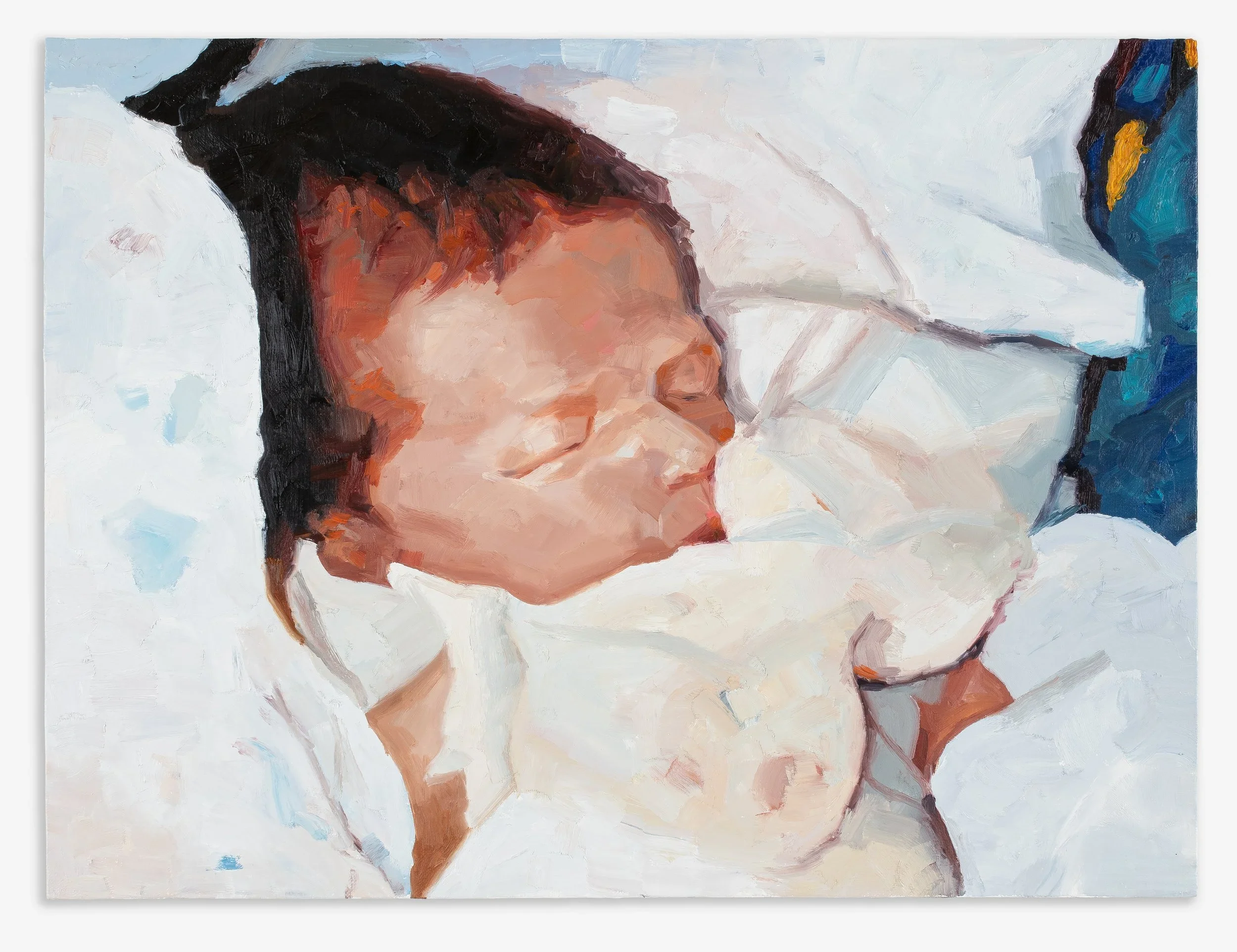
In Kahn’s Daughter (2021), a baby announces her arrival in the world, quietly and cozily in the father’s arm. The image comes from the technologist and entrepreneur Philippe Kahn. In 1997, the imminent birth of Kahn’s daughter encouraged him to hastily create a device, so that the newborn could be photographed and the image instantly reached friends and family. It was a touching story, and a powerful one that continues to unpack its implications in contemporary society, in much more advanced and potent ways. Tanmu rebuilds the now unbearably low-resolution image into a tender moment, with dense brushstrokes and mellow colors. I ask, what can an image tell about the dazzling technological developments and the positioning of myself, to consider the most mundane, private, but compelling moments?
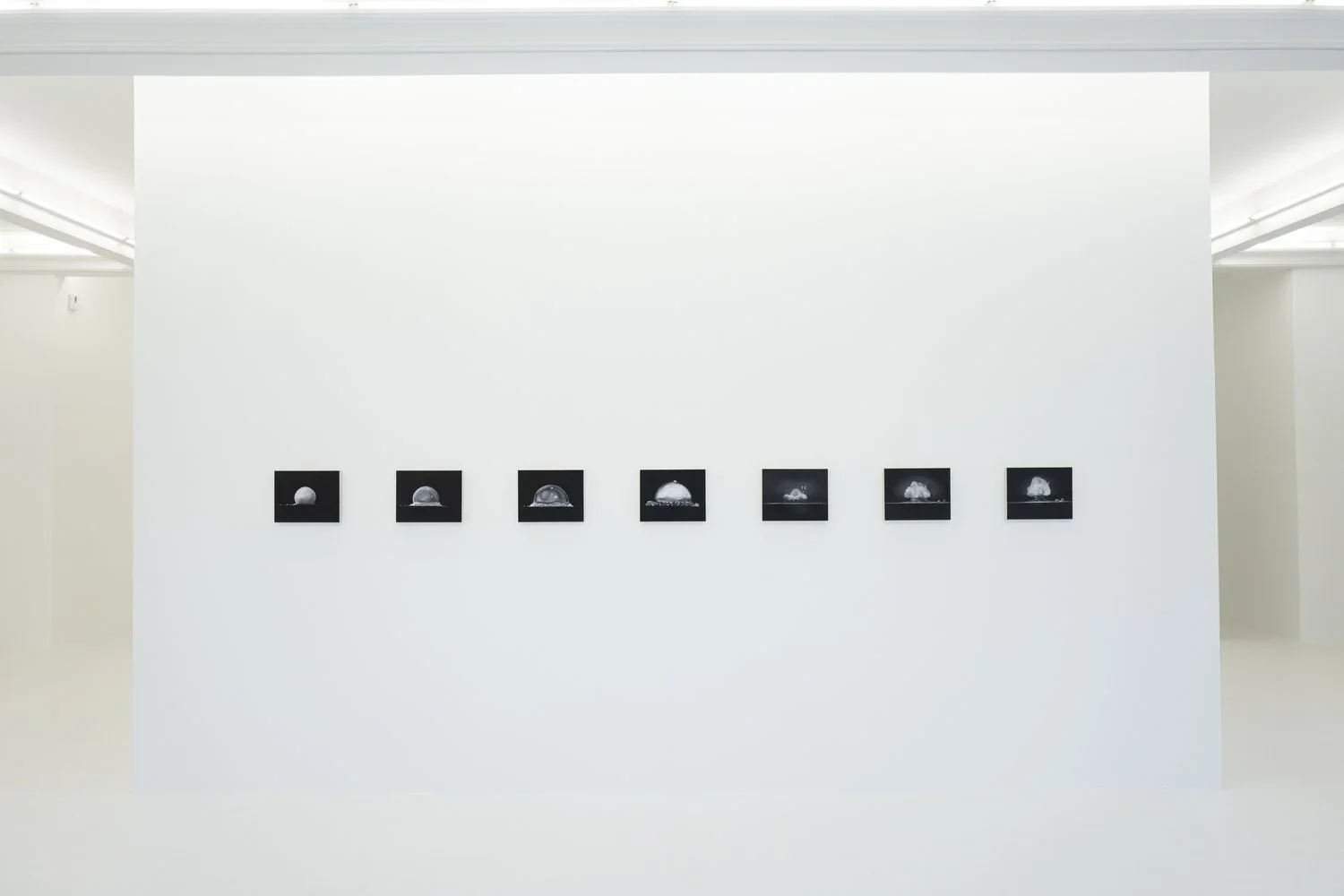
Then I scroll to the Trinity Testing series of 2020. The loud event in New Mexico, 1945, declared the advent of an “Atomic Age.” Each of 11x14 inches, the canvasses are so delicate and dreamlike that one feels they must be appearing in a crystal ball. Of course people have imaginations and dreams, not entirely nightmares, about them. Through a psychological lens, an imaginary is formed and performed thereupon. The nuclear bombs—cheered, detested, yearned for, or abolished—have become such a powerful image and imaginary for the world. The constantly stabilized, disrupted, and rearranged world order does not grant anyone an exit; Tanmu’s series clearly reminds me of this. To recognize the built-in vulnerabilities, live with or challenge them. Alternatively, in the artist’s words, her way of looking aligns with the Chinese philosophical lineage of “ge wu zhi zhi” that investigates things to extend knowledge, examining and discerning objects of various scales and conditions. The paintings are more than knowledge production. Every viewer who bothers to look closely then becomes a reflexive subject of this knowing process, an infinite one by principle.
Grappling with all the evolving, emerging, complicating objects and issues, one can be mesmerized, confused, thrilled, appalled, or like me, all of above, knowing that my position and action further constitute what and how I know. Tanmu’s work disengages from the common thesis in works on science, technology, and media society, such as nostalgia for a derelict utopian vision, withdrawal from or reconciliation with the fragmented experiences, or speculation on an undefined endgame. In an empathetic and avid tone, Tanmu speaks of chronicling the zeitgeist; while I hardly subscribe to the grand narrative embedded with powers and resistances, I do wonder at the effect woven in a painter’s materials, creative processes, images and imaginaries.