
Niente, or painting from memory
This essay takes shape the way this exhibition is built. In his painting and video installation, Channatip Chanvipava retrieves images from his archive, mental and digital, and repositions them to mean something new. I extend that approach to writing. Between the main sections of this essay stand fragments of a paper on mental imagery I wrote in 2018, reading Rachel Kushner’s novel The Flamethrowers, and never published. The thoughts, once fixed in words, float loose again in the service of a new reading.
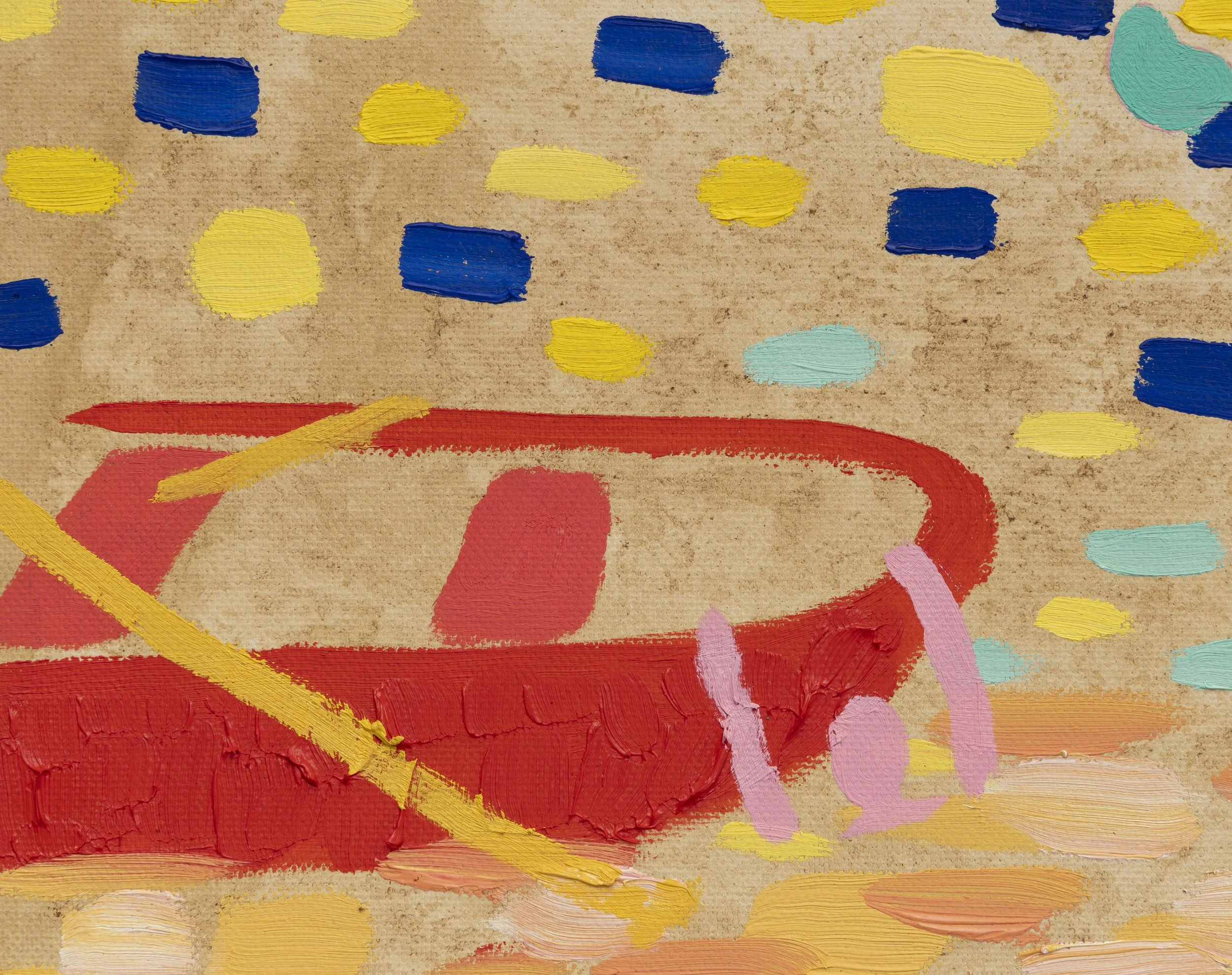
Channatip Chanvipava, Aboard A New Voyage, 2025, Coffee and oil on canvas and wood, detail.
Chanvipava paints without photographic reference or preliminary sketch. The statement is easy to grasp. The paintings, in their assured reticence, indeed evoke Howard Hodgkin’s way of compressing feeling into a few saturated strokes. While Hodgkin speaks of “emotional situations,” Chanvipava takes memory itself as his object, with an ambition to reorganize it and construct its meaning anew. Plainly, he paints from memory. What, then, does the artist look at when he paints? I ask myself that question looking at the sparing brushstrokes of pink that soon resolve into a swimmer lifting their head from the water, reaching for the bow, the orange paddles lying idle at either side. Aboard A New Voyage. The small piece from the Memory Box series is an oil and coffee on canvas, framed in wood, with flecks of coffee grounds visible at the edges. Loose dashes of blue and yellow crowd the upper half of the painting, warm into orange and pink below, and spill over to wrap both sides of the frame. We see these colors animate a simple composition; what did the artist see as he painted the figure and the water surface, and how?
One important image, which inspired Persona, is of two women wearing hats and sitting on a beach and comparing hands. …Bergman further touches upon the apparatus of mental imagery, recalling how some images kept returning to him as if independent of his will and consciousness, demanding a context in which to take place. How does mental imagery grow and expand across the narrative? How is imagery viewed and experienced during the creative process?
Consider two experiments, a century apart. In 1910, Cheves Perky asked her subjects to fixate on a point on a screen and imagine a familiar object—a tomato, a leaf, a banana—while an image of that object was projected onto the back of the screen, just above perception threshold and in soft focus. None of them realized a real image stood before their eyes. Meaning to imagine the banana lying on its side, they found it standing on end, as the projection had it.[1] The Perky experiment unsettles that doubtful boundary between visual perception and mental imagery—how they overlap, and how they supply the image painted from memory. A 2023 update by Nadine Dijkstra and Stephen Fleming inverts the confusion by locating a “reality threshold”: when an image is vivid enough, whether from the outside world or from the mind, it is experienced as real.[2] Perky’s subjects took the real image for an imagined one, and the 2023 experiment shows that the imagined can pass for the real. We sort images by their source; memory is never sure of its answer. To remember is already, in part, to imagine. To paint from memory, in this sense, is to work at the exact joint of seeing and inventing. In this light, the pink figure lurking between the red boat and the orange water, ambushing the closer look, reads as autobiography—from between the colors the protagonist emerges.
The Perky experiment came to ask where the boundary between visual perception and mental imagery lies. Do the two categories function separately or reside on a continuum? If, in fact, the two categories reside on a continuum rather than separate distinctly from each other, what primarily makes the image of the mind? What then makes the image of art?
In Slow Dancing, the large painting that commands the main gallery, a powder-blue sofa holds the center, built of the same thick, wavy, continuous strokes that define the rest of the painting, from the more legible references—the power cables of Bangkok’s streets—to a corner where yellow thickens against dark blue, cut by dashes of orange and green. The sofa, as Chanvipava writes, stood at the end of a bed in his London home, a piece of intimacy and warmth. Yet the soft hue of the sofa presides over the clash. Painted from this fond memory, the sofa is no longer the one in London, an image in storage, but one coming to life on canvas, gathering to itself everything that the search for it stirred up. From this sofa a rose grows, and a dash of red—a fallen petal, or a reflection—an extension of its existence. Memory is painted out anew at each recall.
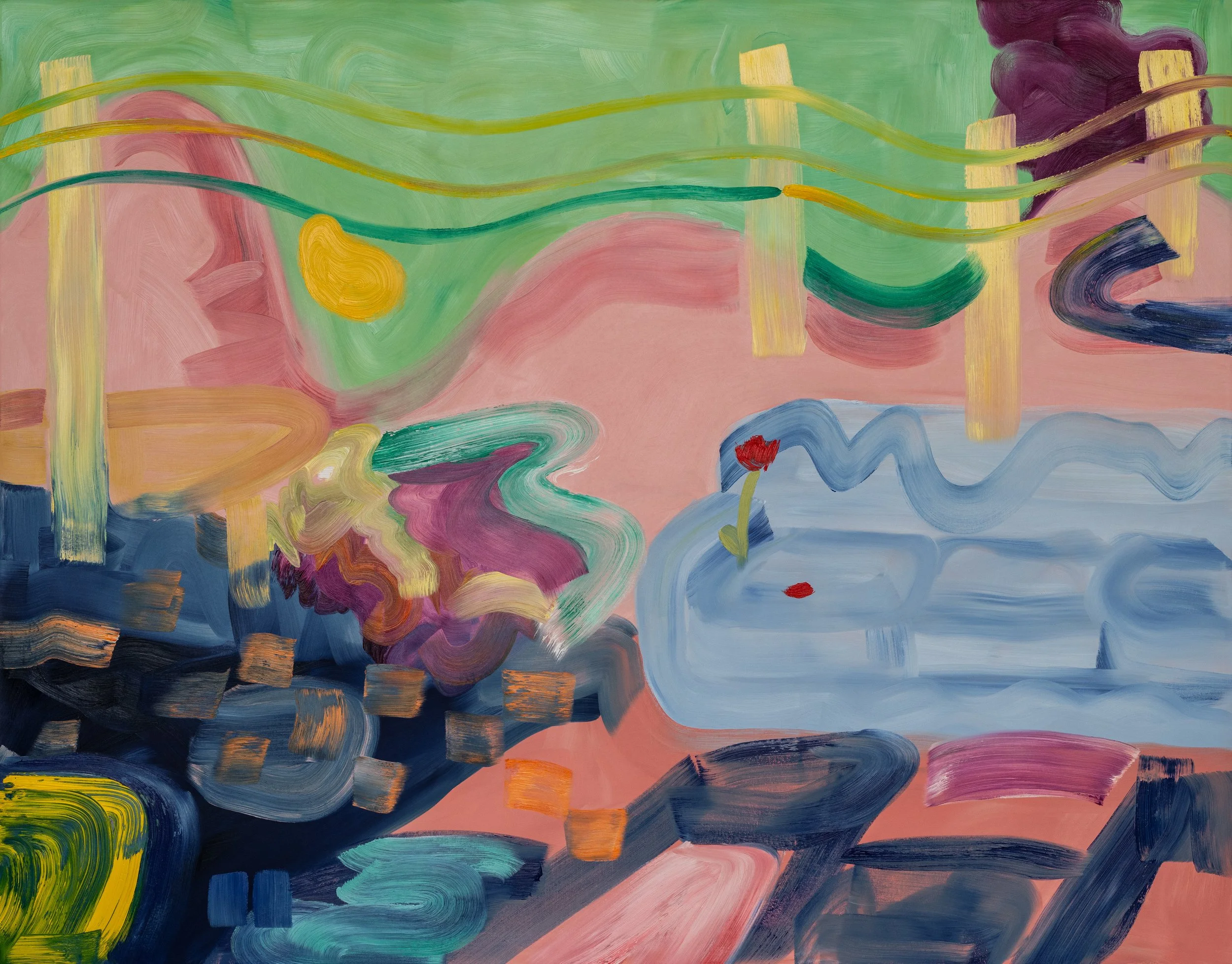
Chanvipava, Slow Dancing, 2025, oil on canvas.
Imagery of the woman and the engineers that sparked Kushner’s writing in the first place became for her a visual experience…and also a mental experience that continues to expand when evoked, evoking new elements in memory. Memory exists as the China girl that Reno once plays for the film studio (the anonymous woman spliced into a film leader to calibrate its colors), evading notice when it correctly enters the strip and only causing flashes of shock if not properly loaded.
The sofa, the rose, and the intense swirl of colors have spilled out of the canvas to become an oversized, distorted reflection on the floor. The room leads the viewer straight into that reflection on entering, though I notice how quickly most step off, alarmed at their own trespass on an exhibition object whose colors rush at them, until they circle it to confirm the medium and the intention of the installation. A small patch of mirrored reflection on the opposite wall closes the circuit of a painted world. Parallel black ropes evoking the power cables run between architectural structures, suspending the boundary between constructed, subjective space and the room. The works bleed, compulsively, into the physical room shared with viewers, who see, in their minds, what is withheld beyond the visible—that the sofa expands beyond the frame, that the cables run through the walls, that the exhibition continues in the viewer’s own memory. The viewer completes the image from recall.
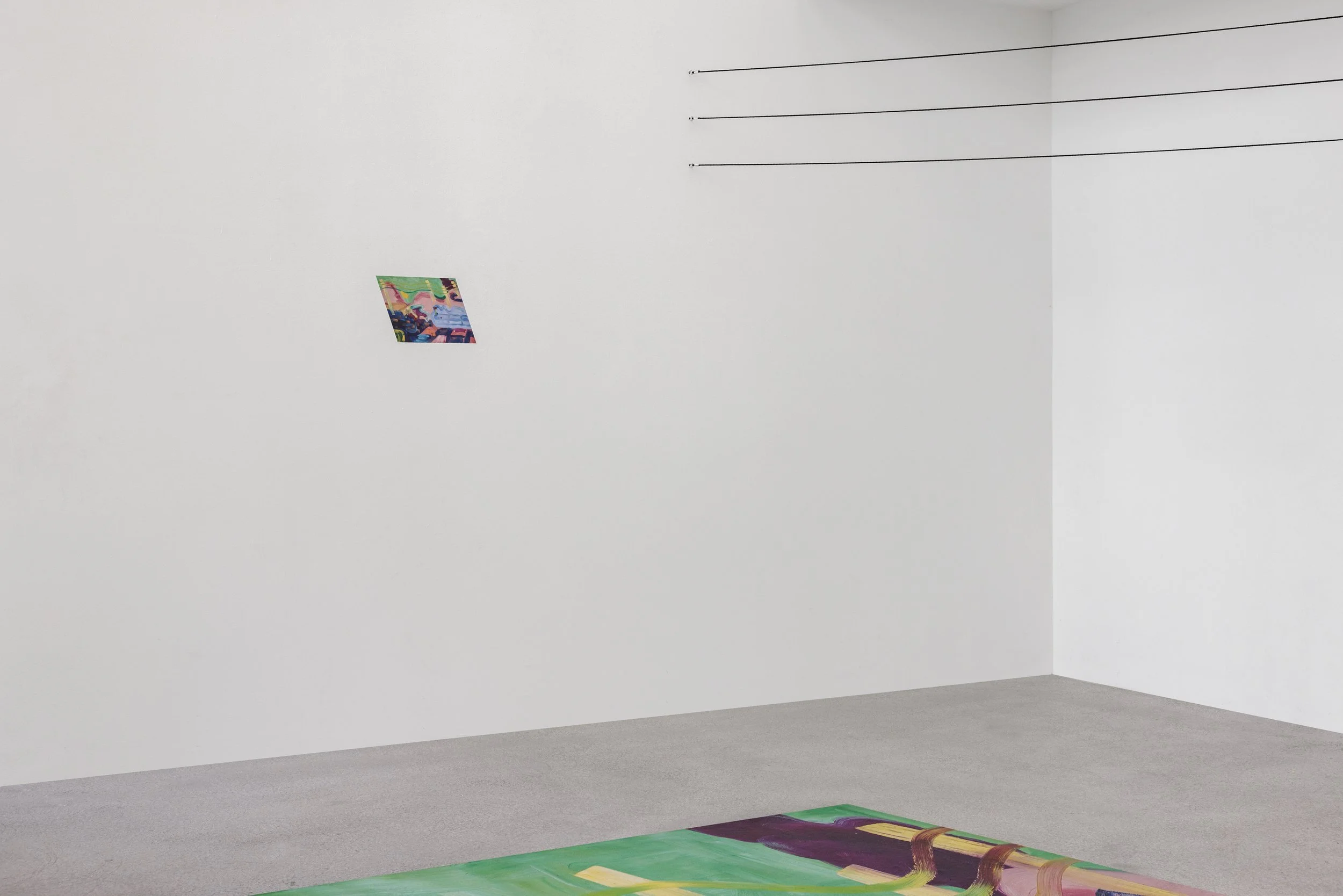
Install view, Channatip Chanvipava: Parallel Worlds at BEK Forum.
Once extracted from the author’s memory and translated into the story, the imagery immediately seeks shelter in a reader’s mind and marches on to realize its full spectrum of possibilities. The validity of imagery is predicated on whether and how the image is absorbed by its reader…its potential is absorbed into the reader’s memory without instantly releasing all its energy upon entering.
The flow of imagery and the connections formed are described by Ingmar Bergman, recalling his process of making films—running each frame of the filmstrip across an editing table: “I can still feel the rising sense of magic from my childhood: there in the darkness of the closet [with my magic lantern] I cranked forward one frame after another, saw the almost imperceptible changes, cranked faster: a movement.”
The video Parallel Worlds seems at first a counterpoint to this highly subjective space: a decade of the artist’s archive footage, disclosing at last the kind of source his painting practice withholds—though what it shows is not the personal memory but its machine counterpart. In this two-channel video installation looped over three and a half minutes, personal and digital memory vie for primacy. The footage, with its original sound—memory accurately stored, filed by device and timestamp—is back in the hands of an imperfect rememberer. The clips are fragmented, reconfigured, juxtaposed on two channels, and projected onto two primed canvases. Street scenes trailing the power cables and serene views of the landscape—of Inle, Luang Prabang, Los Angeles, Kuala Lumpur, the Mediterranean, as Chanvipava describes—are overrun by animated brushstrokes drifting over the footage; again, power cables reach outside the frame, a rose springs from the sidewalk and glitches away. Chanvipava notes that this first video work was conceived in a period when he found himself without a studio and turned to the screens—the video clips taken on a succession of iPhones and stored in the cloud. What is left to see, when images of such perfect accuracy are so plainly displayed?
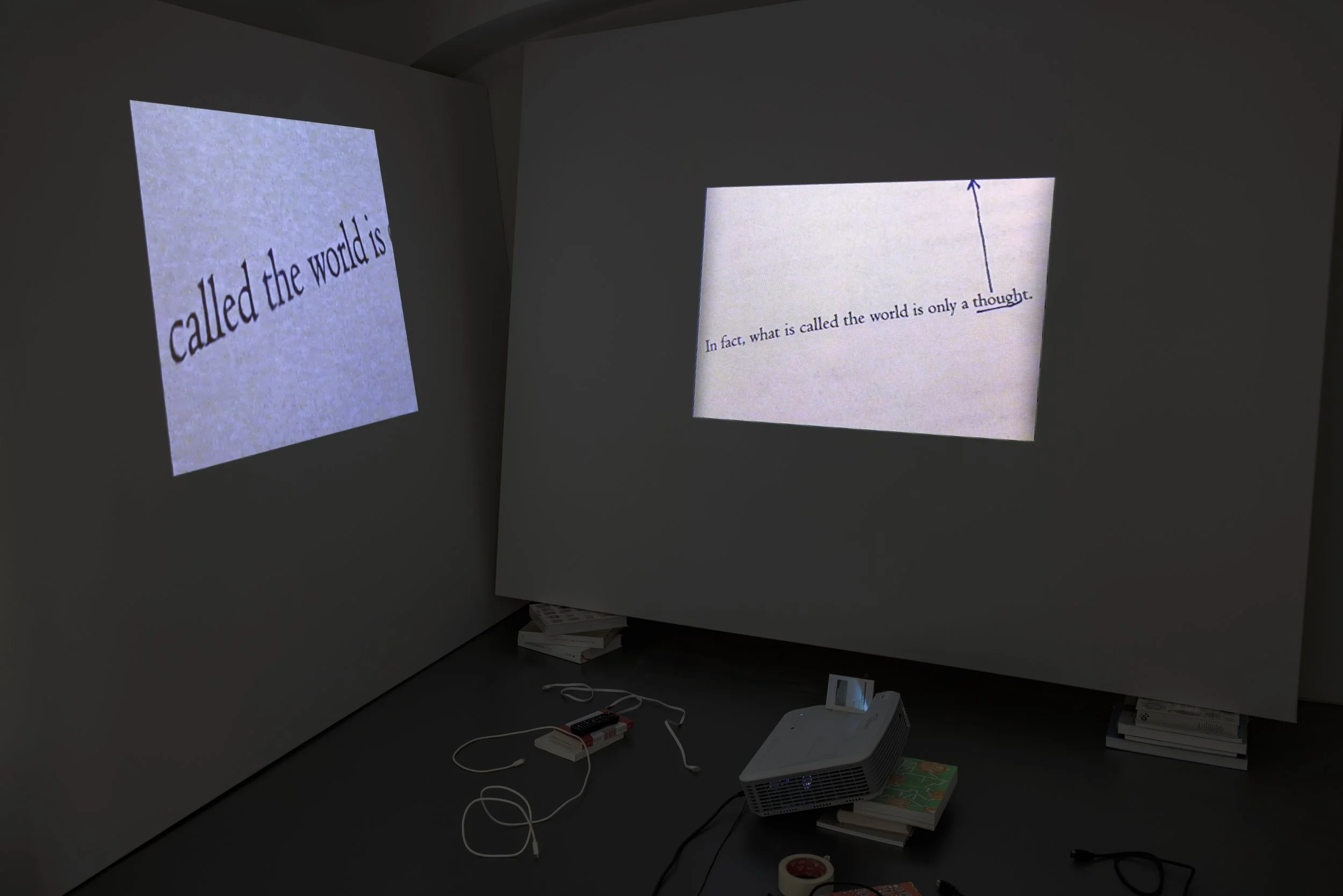
Chanvipava, Parallel Worlds, two-channel video installation, 2026.
Beckett considered memory insensitive and inhuman, but found in it “the basis of subjectivity.” In his notes, Beckett cites Augustine’s comparison of memory to the “belly of the mind and joy and sadness the sweet and bitter food…when committed to the memory, are, as it were, passed into the belly, where they may be stowed, but cannot taste.”
When Kushner asked a mysterious Italian woman—once the girlfriend of a member of the Red Brigades and deeply involved with the movement—what she did at the time, the woman replied “niente”(nothing) with a smile.
Niente. It is not that there is nothing to see in the photographic images, but that the video is about what memory holds and refuses to tell, what remains private even in disclosure. “What is called the world is only a thought.” This is a line from Einstein and Buddha: The Parallel Sayings that Chanvipava inserts into Parallel Worlds. If remembering and imagining are made of the same material, then to revisit a memory, a “found memory” as the artist describes it, is to rebuild a world in a small and exact sense. The artist enters his video archive not to remember the past, but to alter its meaning. Current memory research in neuroscience holds that remembering the past and imagining the future run on the same machinery; the faculty with which the artist paints the sofa is the one with which we paint a life not yet lived.[3]
“Instead of causing us to remember the past like the old monuments, the new monuments seem to cause us to forget the future,” Smithson wrote in 1966 in “Entropy and the New Monument.” Words become “dead letters” when stripped from the mental process that physically creates them.
Towards the end of Parallel Worlds, one channel of the installation turns to a self-driving Waymo car, which, as it navigates by comparing an internal map against live data from its sensors and by predicting a near future, becomes a machine that recalls.
[1] Cheves West Perky, “An Experimental Study of Imagination.” American Journal of Psychology 21 (1910), 422–52.
[2] Nadine Dijkstra and Stephen M. Fleming, “Subjective signal strength distinguishes reality from imagination.” Nature Communications 14, 1627 (2023).
[3] Daniel L. Schacter and Donna Rose Addis, “The cognitive neuroscience of constructive memory: remembering the past and imagining the future.” in Jon Driver, Patrick Haggard, and Tim Shallice (eds), Mental Processes in the Human Brain (Oxford, 2008).
Essay for Channatip Chanvipava: Parallel Worlds at BEK Forum Vienna, 29 May – 25 July 2026.
The essay is included in the exhibition’s online archive by Open Forum.
