
Everything on the Line
Dipping into a sea of stars
A network of connections
fragile, human
The sound of a string
Vibrating in infinity
everything on the line
Imagine the world connected through a taut string that could rip at any moment. A fragile yet beautiful nexus creating tension between the sky, the earth, and us as human beings. The strings of technology come to life on the strings of art, an invisible line converting the artworks into music and vice versa.
The performance Everything on the Line was conceived to convey Tan Mu’s art through music. It was rooted in the belief that music can act as a catalyst—connecting artwork and audience, emotion and intellect. For me, connection was the central concept of the exhibition.
The first time I encountered the Signal series, I felt magnetically drawn to the canvas. Some elements became clear only through explanation; others resonated instantly. I began reflecting on how to translate that multi-layered depth into sound—how to make the art's inherent connections tangible to an audience. Because for me, music in an exhibition like this only makes sense when it serves as a bridge - between the artwork’s inner logic, the presence of the listener, and the countless connections they themselves carry into the space.
The question was: how?
From a personal perspective, art extends beyond the physical object. It is something that happens between the artwork, the audience, and what I’ll call—if you allow me—the cosmos. It transcends the visible, the material. That’s why I wanted to create a performance that allows the audience to experience this art beyond the canvas. An art that begins with Tan Mu free diving into the ocean, putting her hand on a canvas, sharing her thoughts with her curator, presenting her work to an audience, the audience reflecting on it with friends, and so on. The work itself generates a network—one that surpasses time, geography, and the gallery walls.
To symbolize this expansive connection, we introduced a long strand of blue yarn, representing the submarine cables from the Signal series. This yarn physically linked the musicians to the audience—inviting them into the canvas and the global network it alludes to. We didn't know whether the audience would hold onto it, let it go, or pass it along to another person. But that was the point—it was their choice. Would they remain connected? Would they send a signal by pulling, or allow themselves to be pulled?
The ends of the yarn were held by two musicians: Chatori Shimizu, an extraordinary Shō player and composer, and myself, a harpist and concert designer. For this performance, we chose portable instruments—the traditional Japanese Shō and a Bohemian harp strapped with a shoulder belt—allowing us to move freely among the audience and the works. We represented the beginning and the end of the yarn—but not of the art. Our goal was to extend it beyond the moment of the performance.
In preparation, I studied the lines in the Signal series and realized they could be interpreted as a kind of graphic score, reminiscent of the work of John Cage. I didn’t want to impose a musical language on the artwork—I wanted to read the music that was already there. So Chatori and I sat down and quite literally “read” the canvas. It was a joyfully intuitive process, and we wanted to share that joy with the audience.
Each guest received a printout of a submarine cable map from somewhere in the world. They were invited to mark the part that resonated with them—and we would then interpret that choice musically, either by approaching them or allowing them to come to us.
The performance revolved around three central gestures:
A yarn connecting everyone—musicians and audience.
A sense of agency—audience members choosing their own map and interaction.
A canvas—providing musical inspiration and structure.
Through these, we hoped to create a lasting, lived experience of the artwork.
I remember many inspiring conversations with Tan Mu, her curator Nick Koenigsknecht, Chatori, and the BEK Forum. This was a collective process—a new kind of network that formed in and beyond the exhibition space. A beautiful interplay of invisible threads connecting our differences, similarities, and shared curiosity.
A network only functions with multiple points of contact. If one disappears, the line loses its purpose—there is no line without connection.
Everything on the line.
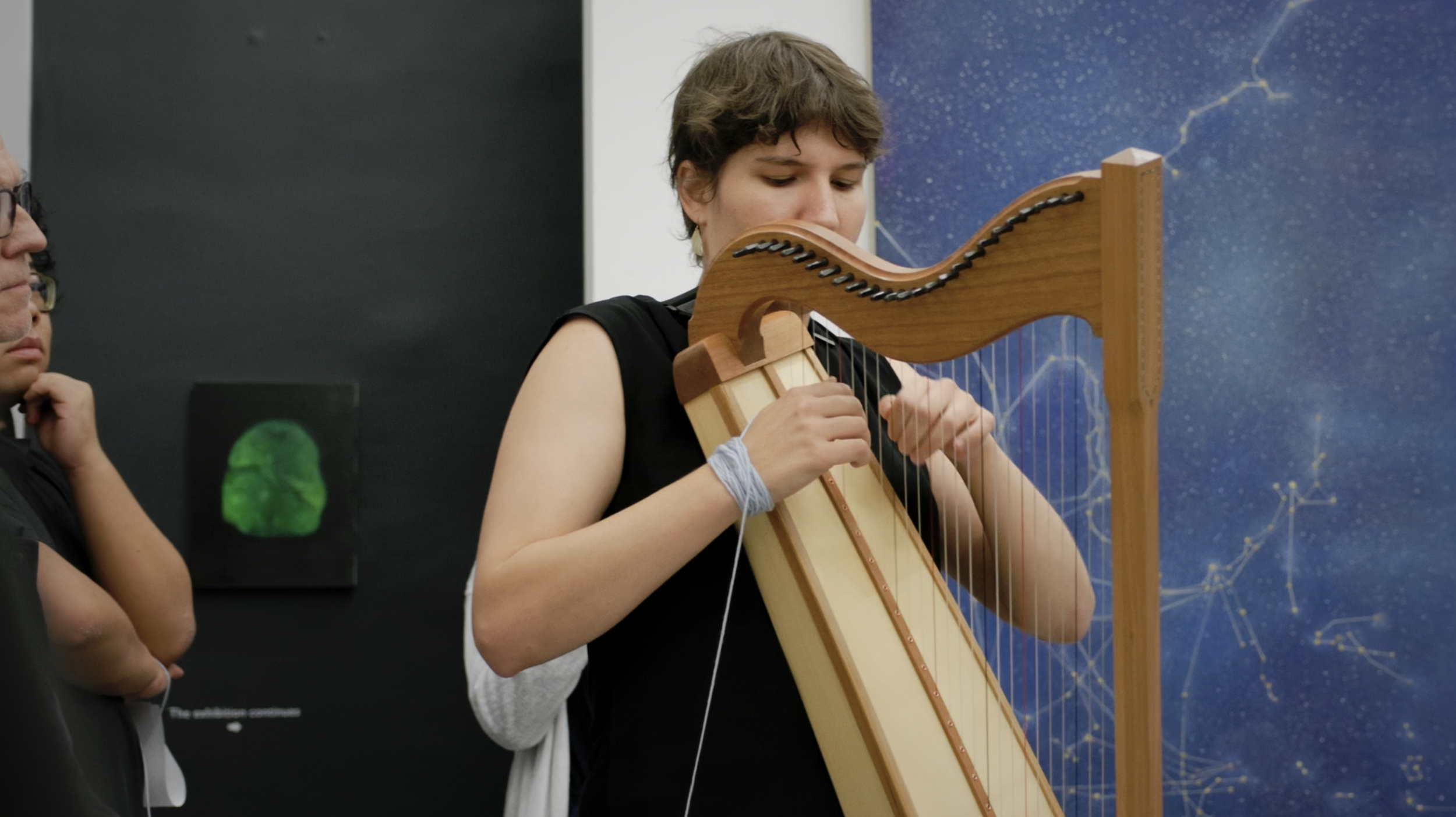
Sophie Steiner is the harpist and concept designer of the performance Everything on the Line. Besides her career as a soloist, chamber, and orchestra musician, she promotes new performance concepts and was awarded the Masefield prize 2015. Within her aim to overcome cultural, social, and personal borders through music, she founded the ensemble "BreakingBorders" and has initiated the festival "Shirabe" to enhance intercultural understanding, respect, and exchange worldwide through art.
The essay is included in the catalogue Tan Mu: Signal.
