
Tan Mu’s black hole paintings
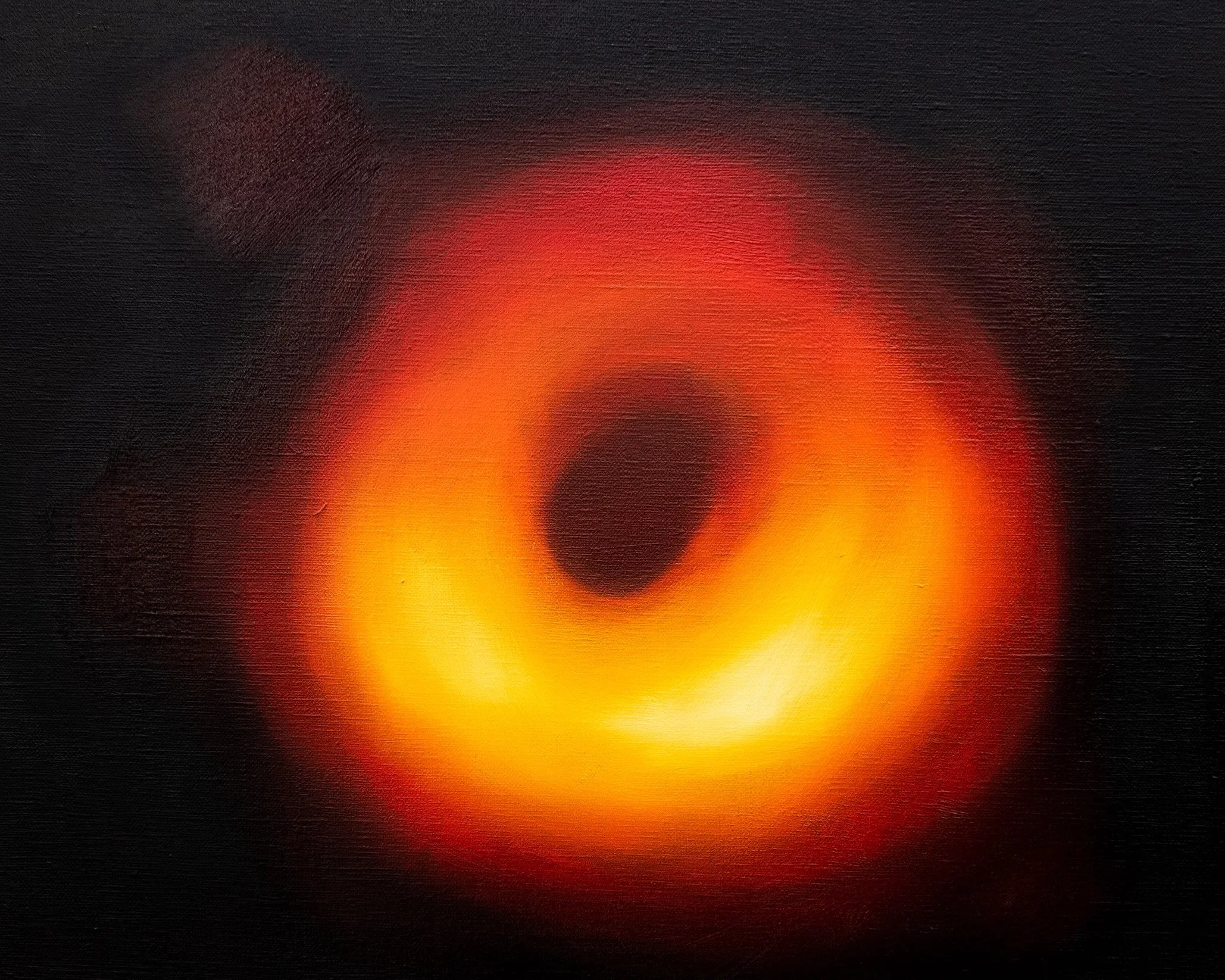
Tan Mu, Powehi, 2022, oil on linen, 61 x 91 cm (24 x 36 in), details.
Contemporary painter Tan Mu’s painting Powehi (2022) of the Event Horizon Telescope’s 2019 image of the black hole at the center of the galaxy known as Messier 87, is small, just 24 x 36 inches, but its impact is visceral. We face a ring of concentrated orange and yellow, intensely bright, surging out of a deeply black background. This blackness feels immersive, so smooth and matte that it looks not like a surface but like a void. The brushstrokes of the orange ring swirl around with momentum in a spiral toward the central heart, not in a perfect circle but on a slight angle, as if being barely contained by a chaotic central force. The gradient from orange to yellow at the bottom of the ring and back again enhances this sense of asymmetrical movement, constant motion and change. As you look longer, faint red patches around the outside of the glowing ring draw your attention, barely perceptible in the darkness, like faint steam escaping from this churning entity. The painting feels initially monochromatic, because of the contrast between the glowing orange and the absorptive black, but before long it feels like there are about a thousand colors on this canvas. And there are in fact many, many layers of various colors here, laid down in thin, transparent, glaze-like applications in precise timings as they partially dry.[1]
Tan Mu’s process is both meditative and analytical, rooted in close observation of her source material and the particular bodily experience of painting. This combination of human presence and technical procedure activates her practice, which is part research, part documentation, and part commemoration of our age of rapid technological and earthly change. Computing has made our worlds both smaller and bigger, allowing us to affect the natural world on an unprecedented scale. It puts us in touch while also severing us from each other, and brings distant phenomena closer while also creating a new kind of distance between us and that which we observe. Tan Mu uses her medium as a meditation on the ramifications of technological progress, a form of analysis of the constantly changing interaction between human bodies, memories, histories, and the new tools we are creating. A dedicated archivist, both of technological events in history and of her own artistic practice, Tan Mu positions herself as an observer and a recorder, non-judgmentally crafting unique physical avatars for major technological events that allow her to study those events in all their emotional and scientific complexity.
Tan Mu has painted a huge variety of subjects: biological phenomena like embryos, neurons, and atoms; seemingly mundane objects like punched cards, television test patterns, and vaccine vials; and landscape-scale sites such as massive data centers, Bikini Atoll, and the 2021 Gulf of Mexico oil spill. Her source material is frequently a digital photograph, which she then meticulously translates into a painted surface—often an image from news media or from an archive that is just one example of a proliferation of images of a particular historical event, invention, or technological or scientific phenomenon. She transforms it via painting into a monument imbued with specific, time-bound, non-reproducible human labor.
This feels especially impactful in the case of the black hole image, which is not a photograph in the typical sense of the word. It is a scientific image that was created through a combination of technological processes deployed in a new way. The Event Horizon Telescope (EHT) is a network of eight telescopes that gathered radiowaves, as frequency measurements, coming from the black hole all at the same time—the only way to gather data on a scale big enough to discern any detail in the structure of this distant object. The established technology of digital imaging and photography was used as the framework for using this data, in the sense that frequencies can be mathematically treated as the distribution of brightness across a two-dimensional surface. It is thus possible to discover what a digital photograph of the physical structure that would produce those frequency measurements would look like. That is to say, we can construct the digital photograph that we theoretically would have if it were possible to photograph a black hole.
In a situation like this, where the lines between the created and the discovered, between the natural and the technological, have become so profoundly blurred, it is revelatory to encounter this painting, in which Tan Mu radically un-digitizes this image. To translate it into a technically precise painting—to take it from something numerical to something sensorial and phenomenological and allow for us to see it in that form—feels intensely appropriate, like it gives the black hole image a physical form that does justice to the combination of humanity and the natural world that it embodies. As Tan Mu discussed with me, painting is a way to create tension with the digitization and programmability of everything; it is attached to one moment in time, totally unique.[2] It is also attached to memory, linked to the artist’s body. It is inherently subjective, personal, and experiential, and is not predictable, reproducible, or scalable. Painting brings the black hole image to human scale, brings back in temporal specificity and sensorial ambiguity.
To be clear, Tan Mu’s painting is carefully faithful to the visual characteristics of the Pōwehi image, including the precise interaction of the various colors and the details of the swirling shape. Tan Mu described to me her awareness of the fact that as she laid down each tiny stroke, her brush travelled a few light-years.[3] This precision and technical diligence combined with the tactile presence of brushstrokes and the materiality of the paint itself means that the work is able to convey a sense of the depth and complexity of the information contained in the black hole image, while also existing as a self-contained object, something we can be with in space and relate to intuitively with our bodies. Tan Mu’s turn to the medium of painting, after starting out with new media works that used programming, mechanical sensors, and screens, was in fact motivated by the desire for this kind of fixed, self-evident physical thing that one can access and sit with for an extended time.[4]
The brushstrokes suggest the motion, fluidity, and ambivalence inherent to the black hole itself, and the medium of painting, perhaps our most historical of mediums (we have cave paintings from 40,000 years ago, after all), in a way feels like an appropriate container for this kind of visual thing, this outcome of scientific efforts to escape the boundaries of ourselves and visualize the unvisualizable, something that is as far away from us as we can imagine, but at exact same time inseparable from us. Tan Mu thus helps us with the daunting task, for scientists and non-scientists alike, of attempting to engage with and understand the black hole itself, a celestial object that does not adhere to any rules of space or time of which we can easily conceive and for which we often need supernatural metaphors. The name “Pōwehi” reflects this, as it draws on a sacred Hawaiian chant (two of the EHT telescopes are in Hawaii), and the word describes a powerful creative darkness adorned with a crown.[5] As Tan Mu writes, “how can painting re-establish a relationship between humans and a world beyond direct perceptual capacity?”[6]
When the EHT followed up this image a few years later with the announcement of another made using the same technique of a different black hole known as Sagittarius A*, Tan Mu accordingly painted it as well, making sure this discovery/creation was also given its place in her archive. This painting translates the black hole image in exactly the same way, through a process of studying the very different character of this other smaller black hole, whose fiery orange ring of orbiting gas is articulated with three bright yellow spots that pull against each other in tense triangle.
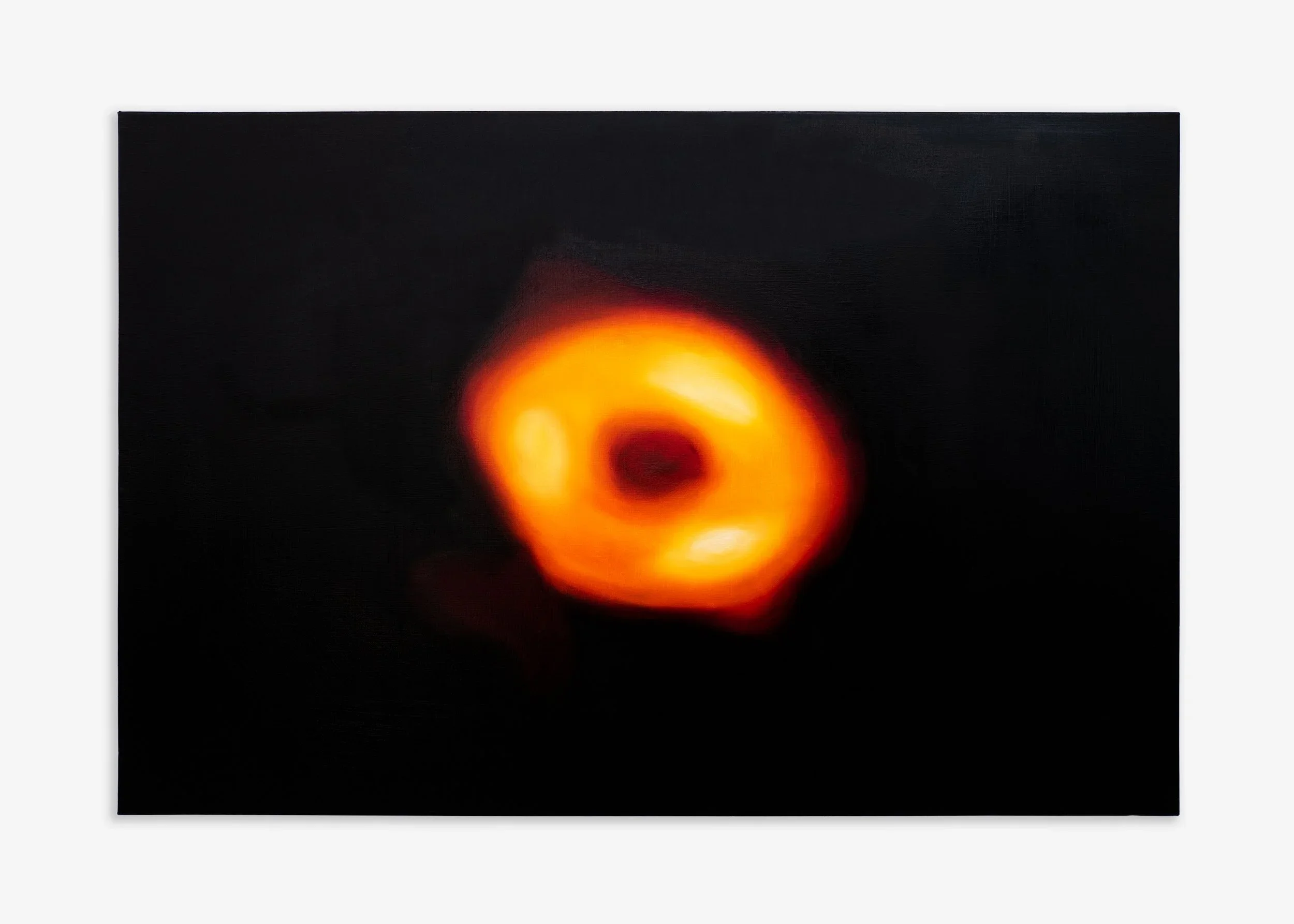
Tan Mu, Sagittarius A*, 2022, oil on linen, 61 x 91 cm (24 x 36 in).
Painting against the logics of contemporary seeing
Other works in Tan Mu’s oeuvre offer a similar kind of salve to the cold detachment and endless reproducibility of the technological images we are inundated with in contemporary life. The paintings pull the digital and the computable into a more tactile, analog realm of precise but unpredictable material phenomena. MRI (2021), which depicts a scan of a human brain, conveys the very digital feel of an MRI through certain characteristics—a systematic color palette, a certain combination of exact detail and the lack thereof—but does so via visible brushstrokes. We can see the streaks and partial blending and the appearance of the painting process, but these become elements of technological vision. We should note that MRIs are produced via similar principles to the ones behind black hole imaging, and many other kinds of scientific imaging, in the sense that radiowave frequencies are measured as they interact with the brain, and these frequencies are treated as patterns of light and dark.
In a small painting called Error (2022), Tan Mu again uses her brush to reproduce a computational visual effect. Viewed close up, we see in the tiny brushstrokes the texture and idiosyncrasies of a human hand; viewed at a distance, it turns out that the precision and control with which she painted the letters uncannily suggests the characteristic glowing flicker of a digital error message. These works and others operate like artifacts in a museum on the milestones of our computing history, exhibits in a future museum about us—the kind of thing that could be excavated by a future society and would convey something about how we operated.
Large Hadron Collider (2026) depicts the ATLAS detector at CERN. This piece of machinery appears within the frame of the painting as a portal, drawing us in via one-point perspective toward the space within where particles crash into each other and potentially reveal other dimensions. The various complex parts are reproduced accurately and realistically, as is the distortion caused by the wide-angle lens that produced the source photograph, but in paint, the components appear not like cold metal and electronics but like woven cloth or swirling liquid. The gleam of the metal translated into paint suggests motion. The painting thus intimates the natural and spiritual content of this highly technological setting.
In her work more broadly, Tan Mu draws on neuroscience and computer science in equal measure, in addition to texts and concepts from Chinese philosophy and her own family history and biography. And in certain imagery, Tan Mu directs her attention to the earth, as both a microcosm and a macrocosm of other phenomenon, including in her recent ongoing series Signal, which consists of large-scale maps of the networks of undersea cables that traverse our ocean floors. These paintings might remind us of maps that depict flight paths around the globe, which also take the form of lines and nodes. But unlike those lines, these paths are geometric, and look more like constellation drawings. These are mechanical connections between natural locations, dancing around in convergences and alignments that respond to and accommodate geologic shapes, coastlines, and trenches. Again, Tan Mu’s subtle and precise handling of her medium means that many-layered blue of the ocean, filled with countless tiny dots, is mesmerizingly three-dimensional and interwoven with light, and the lines and nodes themselves glow. Her technique here has clearly developed across multiple bodies of work, as we also find this glowing accumulation of dots amid deep blues in her Horizons series (2024), which is based on views of our planet from the International Space Station.
Between the inviting blue that feels like both ocean and sky, the innumerable specks that float within it, and the intricacy of the line patterns on these large-scale canvases, a viewer is inclined to gaze at the Signal paintings for a long time, situated just between something very soothing and something deeply overwhelming. We are faced with the scale of human intervention on this planet; the ocean as both a natural force and a constructed, engineered environment. Tan Mu has spoken about how her grandfather’s work as a marine engineer gave her a sense from a young age of the vast, complex constructions that exist in the sea, and here we are invited to reckon with the overwhelming amount of physical industry that is required for technology that often feels to us to be light and seamless in our hands.[7]
Tan Mu is deeply interested in the brain, and in the alignments that can sometimes appear between neural networks and other systems, both biological and computational. It is very important to her that these networks of ocean cables transmit human communication, relationships, and memories; they represent human connection on a global scale, our biology merged with both technology and the natural world.[8] Tan Mu is also an accomplished freediver, and the Signal series draws on her experiences underwater, a zero-gravity environment not unlike outer space. Indeed, when looking at the paintings it is possible to mentally float between multiple points of view: the sense of looking up from underwater at sunlight filtering down from the surface, but also being on the ground looking up at the stars, or looking down through the surface of the water to the ocean floor. In these maps we can travel from the physical to the symbolic and back again, from imaginary spaces to earthly ones.
As in her other engagements with scientific and technological wonders, Tan Mu avoids judgement. There is no collapse into technological utopia or dystopia, more a stance of documentation, which allows us in turn to be overwhelmed and at the same time in a position of slight detachment, which might turn out to be a very appropriate way to feel about the capacities of technology. Elizabeth Kessler, in her work on Hubble Space Telescope images, draws on Kant and Burke and Romantic landscape painting to describe what she calls the “astronomical sublime,” and I think her approach is relevant to Tan Mu’s treatment of her beyond-our-comprehension subjects, whether they be outer space, the brain, AI, or the ocean. For Kessler and the scientists she interviewed, the response provoked by an image’s aesthetics is actually key to its scientific power, to enabling the kind of combination of reason and imagination that is required for both scientists and non-scientists to understand things about the universe, to encounter the incomprehensible and meet it with curiosity. She writes that “instead of a universe that leaves us only with a sense of our insignificance, it becomes a place that we experience as both overwhelming and within our grasp.”[9] Signal powerfully deploys data alongside the imaginative and the symbolic, offering a tangible way of engaging with this vast trove of information.
Atlases, archives, and maps
This brings us back to the black hole images, which Tan Mu approaches with this similar kind of reasoned but reverent documentary instinct. The focus is the human effort to chart the unknown, the way we use scientific methods to reign the universe into something that is tangible to us without reducing it to that which is tangible to us. As mentioned above, Tan Mu’s documentary inclination shapes her painting—Signal for example is an ongoing series she hopes to continue indefinitely—but it also is found in her research and compilation of historical documentation of technology in a project called Atlas.[10] This archive contains materials such as a Bell Labs advertisement featuring a hand holding an undersea cable (an artifact of a time before we were encouraged to forget about the massive infrastructure required for modern communication and think of it as invisible or cloud-like, but instead were presented with it as a tactile presence). Tan Mu also carefully documents all her work and maintains a thorough online catalogue. Her extensive self-archiving also manifests as an artistic engagement with technology, as she employs AI agents to generate and re-generate ever-evolving texts and conversations about her work.
Atlases and maps, as both visual objects and as ideas, are central to Tan Mu’s practice. She has spoken about her relationship to the ancient text Classic of Mountains and Seas, for example, an atlas formed over several centuries from the Warring States period into the early Han, which combines the known, the spiritual, and the unknown.[11] She is focused on our intimate human involvement in scientific investigation, on the continual intertwining of our thought and our tools, and archives, atlases, and maps are all examples of knowledge as a methodical but also creative process. I would argue that this is all very relevant to the idea of painting a digital image of a black hole. It is very difficult to pin down the relationship that the EHT black hole images have to black holes themselves, especially for those outside the sciences who are accustomed to engaging with images as, of course, visual representations. Even for scientists who are used to imaging as a mathematical process, not always a visual one in the usual sense of the word, it is a complex task to decide how to handle the visual characteristics of the images that result from their work.
The idea of a map has been called upon to help. According to interdisciplinary researcher Paula Muhr, who is a member of the Black Hole Initiative, it is crucial to remind everyone that the utility of black hole imaging in science rests not on understanding them as a “passive visual depictions,” by which I think she means transparent, not intervening, having no agency in the relationship between us and what we are trying to look at. Their value rests instead on the ability of experts to subjectively interpret and experiment with the possible relationship of specific features across many versions of this image to characteristics of the black hole, more in the vein of a diagram or a topographic map than a representational, naturalistic image.[12] In this sense, black hole images are epistemic tools, part of a knowledge-making process, not pictures of something already established.
On the one hand, Tan Mu’s painting would seem to extend the black hole image further as a “static,” single image, to draw again on Muhr’s discussion, defining its appreciation as that of a visual representation, a picture. On the other hand, however, if we think back to Tan Mu’s interest in maps that combine the known and the unknown, her approach to an atlas as an artistic project, and the way in which she studied and reproduced the black hole images, the paintings also carry forward a map-like character. In translating the digital image into brushstrokes, the link between the visual object and the data underneath it is lost. Just the surface is shaved off and we can access only the visual, material indicator of the underlying information. But the result still “maps” onto the black hole itself, its relation to the black hole is not one of visual matching but one of measurement and conventions; it is no further away from the way a black hole “looks” than the digital image is. So, in viewing it, we are perhaps given the opportunity to directly encounter and more intuitively understand something very true about the black hole images—and about scientific visualization in general—that they show a mix of the known and the unknown and involve layers of interpretation. We can shed the assumptions we normally bring to technology and readily grasp that it is full of ambiguity, human judgement, and specific moments in time.
[1] Tan Mu, conversation with author, May 11, 2026.
[2] Ibid.
[3] Ibid.
[4] Ibid.
[5] Clara Scheidle, “Pōwehi: The First Photographed Black Hole,” Ke Kalahea, 2019, https://hilo.hawaii.edu/news/kekalahea/powehi-the-first-photographed-black-hole-2019. This student journalist mentions that the word for black hole in Hawaiian,“lolelipo,” translates as “to turn the darkness inside out.”
[6] Correspondence from the artist, August 12, 2026.
[7] See the text on https://tanmustudio.com/signal (generated through AI based on notes compiled by the artist).
[8] As she writes, “I think of technology as an extension of the body and as a form of externalized memory.” See https://tanmustudio.com/atlas-of-seeing.
[9] Elizabeth Kessler, Picturing the Cosmos, (University of Minnesota Press, 2012), 175.
[10] See this work at https://tanmustudio.com/atlas-.
[11] See Tan Mu’s writing quoted here: https://tanmustudio.com/signal (essay generated through AI based on notes compiled by the artist).
[12] Paula Muhr, “The ‘Cartographic Impulse’ and Its Epistemic Gains in the Process of Iteratively Mapping M87’s Black Hole,” Media+Environment 5 (1): 2023. https://doi.org/10.1525/001c.88163. See also the Black Hole Initiative, https://bhi.fas.harvard.edu/.
Colleen O'Reilly completed her PhD in History of Art and Architecture at the University of Pittsburgh in 2018 with a specialization in the history of photography. Her research is on the use of visual media in education, conceptions and practices of visual knowledge, and intersections between art and science. She lives in Hamilton, Ontario.
